Printable Deed Document for Indiana
The Indiana Deed form plays a crucial role in real estate transactions within the state, serving as the official document that transfers property ownership from one party to another. This form is essential for both buyers and sellers, as it outlines the details of the property being transferred, including its legal description and the names of the parties involved. Additionally, the Indiana Deed form requires the signature of the grantor, the person transferring the property, and may also need to be notarized to ensure its validity. Various types of deeds exist, such as warranty deeds and quitclaim deeds, each offering different levels of protection and assurance regarding the property’s title. Understanding the specific requirements and implications of the Indiana Deed form is vital for anyone involved in a property transaction, as it not only facilitates the transfer but also helps prevent future disputes over ownership. Familiarity with this form can streamline the closing process and provide peace of mind for both parties.
Form Sample
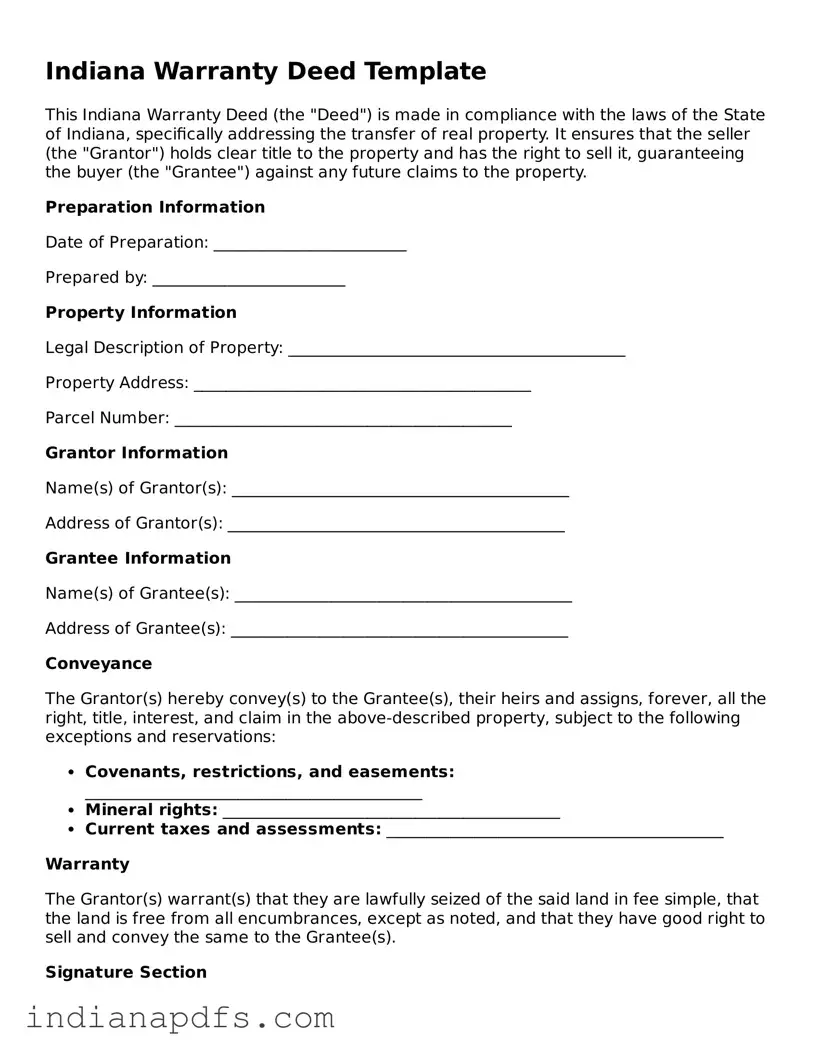
Indiana Warranty Deed Template
This Indiana Warranty Deed (the "Deed") is made in compliance with the laws of the State of Indiana, specifically addressing the transfer of real property. It ensures that the seller (the "Grantor") holds clear title to the property and has the right to sell it, guaranteeing the buyer (the "Grantee") against any future claims to the property.
Preparation Information
Date of Preparation: ________________________
Prepared by: ________________________
Property Information
Legal Description of Property: __________________________________________
Property Address: __________________________________________
Parcel Number: __________________________________________
Grantor Information
Name(s) of Grantor(s): __________________________________________
Address of Grantor(s): __________________________________________
Grantee Information
Name(s) of Grantee(s): __________________________________________
Address of Grantee(s): __________________________________________
Conveyance
The Grantor(s) hereby convey(s) to the Grantee(s), their heirs and assigns, forever, all the right, title, interest, and claim in the above-described property, subject to the following exceptions and reservations:
- Covenants, restrictions, and easements: __________________________________________
- Mineral rights: __________________________________________
- Current taxes and assessments: __________________________________________
Warranty
The Grantor(s) warrant(s) that they are lawfully seized of the said land in fee simple, that the land is free from all encumbrances, except as noted, and that they have good right to sell and convey the same to the Grantee(s).
Signature Section
In witness whereof, the Grantor(s) have set their hand(s) and seal(s) on this date: ________________________.
Signature of Grantor(s): ________________________
Signature of Grantee(s): ________________________
Notarization
This document was acknowledged before me on (date) ________________________ by (names of the individuals acknowledged) ________________________.
Notary Public: __________________________________________
My commission expires: __________________________________________
This Indiana Warranty Deed is intended to be filed with the county recorder of the county where the property is located to ensure proper recording and recognition of the transfer.
Disclaimer: This template is provided for informational and educational purposes only and does not constitute legal advice. Individuals should consult a qualified attorney before making any legal decisions based on this template.
Document Details
| Fact Name | Description |
|---|---|
| Governing Law | The Indiana Deed form is governed by the Indiana Code, specifically Title 32, Article 21. |
| Types of Deeds | Indiana recognizes several types of deeds, including warranty deeds, quitclaim deeds, and special warranty deeds. |
| Execution Requirements | To be valid, the deed must be signed by the grantor in the presence of a notary public. |
| Recording | Indiana law requires that all deeds be recorded with the county recorder's office where the property is located. |
| Consideration | While not mandatory, it is customary to include the consideration amount (the price paid for the property) in the deed. |
| Property Description | A legal description of the property must be included in the deed to clearly identify the parcel being transferred. |
| Transfer Tax | Indiana imposes a transfer tax on the conveyance of real property, which is typically paid by the seller. |
Popular Indiana Forms
Indiana Rental Agreement - Incorporates state and local residential leasing laws to ensure the agreement's compliance with legal standards.
For those looking to protect their sensitive information, a properly drafted Non-disclosure Agreement can be invaluable. This form ensures that shared trade secrets and proprietary data remain confidential, securing a competitive advantage. For further details, explore this guide to creating an effective Non-disclosure Agreement template.
Indiana Power of Attorney - Revoking a Power of Attorney is possible at any time, provided you’re mentally competent, through a formal written notice.